Table of Contents
- What a Check Engine Light Means
- Is It Safe to Drive With a Check Engine Light On
- Understanding OBD-II Scanner Usage and Diagnostic Trouble Codes
- Step-by-Step: How to Use an OBD-II Scanner
- Common Causes of Check Engine Lights
- Cost of Engine Diagnostic Services and When to Get Professional Help
- What to Do After Diagnosis: Reset and Verification
- Frequently Asked Questions
Last Updated: September 30, 2026
What a Check Engine Light Means
Your check engine light is a warning from your vehicle's onboard diagnostics system, and knowing how to diagnose check engine light issues is essential for vehicle maintenance. It signals that something isn't right with your engine, emissions system, or transmission. The light appears on your dashboard when the powertrain control module detects a problem.
It may be minor, a loose gas cap, or serious, like a failing oxygen sensor or catalytic converter. The key is identifying the problem quickly to prevent further damage.
To diagnose check engine light issues properly, you need to read the actual diagnostic trouble codes stored in your vehicle's computer.
Is It Safe to Drive With a Check Engine Light On
A solid check engine light is usually safe to drive on for a short distance. You can get to a repair shop or home without major risk. A flashing light is different. That means your engine is misfiring badly and you should pull over immediately.
Engine misfire causes rapid damage. A flashing light means stop driving immediately, continuing risks catalytic converter failure, which costs thousands more than the original problem.
Here's what to do:
- Solid light: Drive carefully to a shop. Avoid heavy acceleration and high speeds.
- Flashing light: Pull over safely. Call for a tow truck.
- Either way: Get a diagnostic scan within a few days to identify the issue.
Ignoring a check engine light escalates costs. A $200 sensor replacement today could become a $2,000 catalytic converter repair tomorrow.
Understanding OBD-II Scanner Usage and Diagnostic Trouble Codes
Modern vehicles use the OBD-II system to monitor engine performance and emissions. When something goes wrong, the system stores a diagnostic trouble code. An OBD-II scanner reads these codes to identify the problem. Code P0171 means something different than P0300, each code points to a specific issue.
What Are Diagnostic Trouble Codes (DTCs)?
Diagnostic trouble codes are five-character alphanumeric codes identifying specific problems. The first character indicates the system (P = powertrain, C = chassis, B = body, U = network). The remaining characters narrow down the exact fault. P0420 means catalytic converter inefficiency, P0101 points to mass airflow sensor failure, and P0505 indicates an idle speed issue.
Pending vs. Stored Codes: Why Your Light Isn't On (Yet)
Your scanner can show two types of codes: pending and stored. Understanding the difference is critical, it determines whether you need to act immediately or monitor the situation.
Stored codes mean the problem is confirmed and the check engine light is on. The vehicle's computer has detected the same fault multiple times. Pending codes mean the vehicle detected something suspicious but hasn't confirmed it yet, the light is NOT on. These are worth monitoring but not cause for panic.
A pending code might disappear after a few normal drive cycles if it was temporary, like a loose gas cap or cold-weather sensor glitch. It may also become a stored code if the problem persists.
A "drive cycle" is a complete sequence of driving conditions, acceleration, cruising, deceleration, and idle, that allows the computer to test a system. Some vehicles need 3-5 cycles to confirm a fault, others need 10 or more. If a pending code doesn't reappear after several normal drive cycles, it was likely temporary.
If you see a pending code: Write it down and scan again in a few days. If it's gone, the problem was temporary. If it persists or becomes stored, the light will turn on and you need to address it.
After repairs, shops reset your vehicle to clear codes. If a pending code reappears, the fix didn't address the root cause, return to the shop for further investigation.
Step-by-Step: How to Use an OBD-II Scanner
Reading your own codes saves time and money, but not all scanners are equal and safety matters when working near your vehicle's electrical system.
Choosing the Right Scanner for Your Needs
OBD-II scanners range from budget Bluetooth dongles to professional-grade handheld units. Understanding the differences helps you pick the right tool.
Bluetooth dongles ($20-$60) are affordable and portable but slower with limited code definitions. Basic handheld scanners ($100-$300) are faster, more reliable, and ideal for DIY diagnosis. Professional-grade scanners ($500-$3,000+) offer advanced features but are overkill for most check engine light diagnosis. For DIYers, a basic handheld scanner or quality Bluetooth app is sufficient.
Safety Precautions Before You Scan
Before connecting your scanner: Turn off the engine completely. Ensure the battery is in good condition. Keep your hands dry. Never force the scanner into the port, it should slide in smoothly. Remove any cover gently and don't lose it.
Be aware of your surroundings when scanning near brake pedals or steering columns. Hybrid and electric vehicles may have high-voltage systems, consult your owner's manual first. Security system alarms during scanning are normal and will stop when you disconnect.
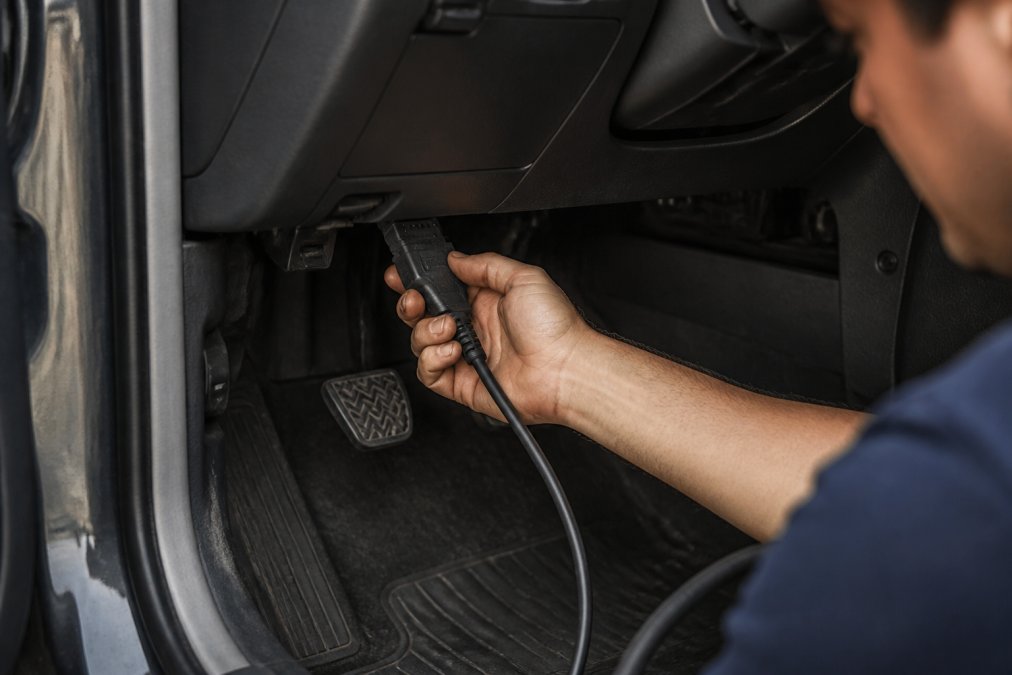
Step 1: Locate Your Data Link Connector (DLC)
The data link connector is usually under the steering wheel on the driver's side, a rectangular port about the size of a phone charger. Check your owner's manual or search online for your vehicle's year, make, and model plus "data link connector location."
Step 2: Connect Your Scanner and Read the Code
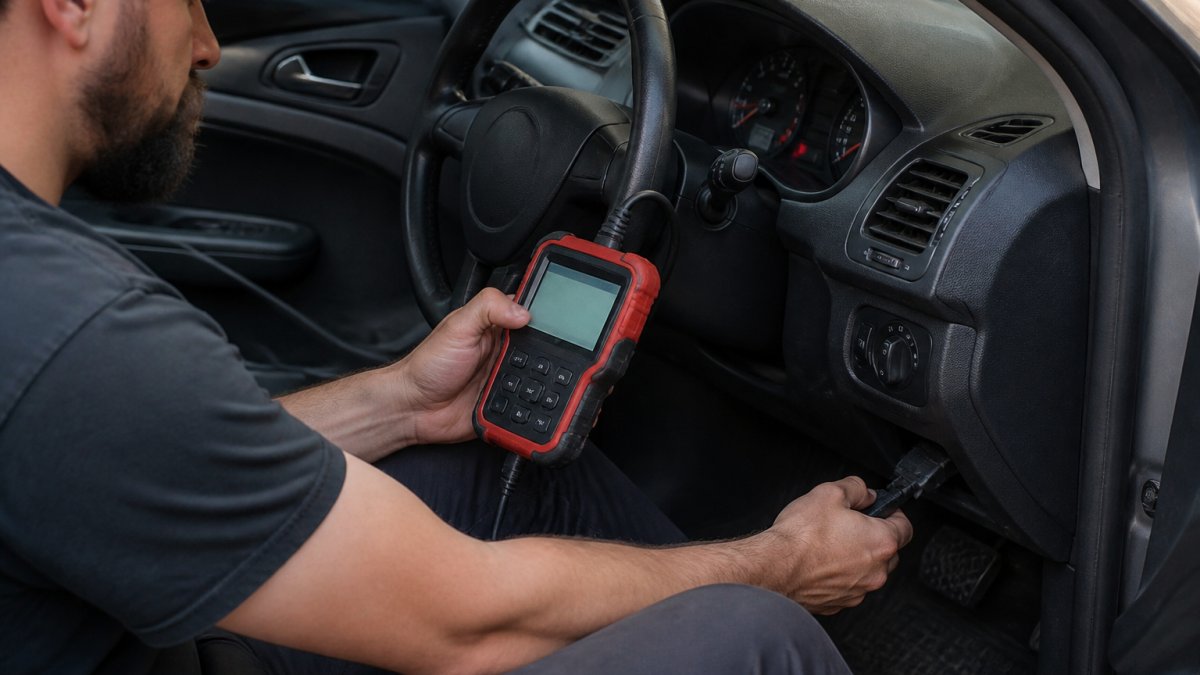
Plug your scanner into the data link connector. Turn the ignition to the "On" position without starting the engine. Your scanner should power up and begin communicating with your vehicle's computer.
If your scanner doesn't power up:
- Check that the connector is fully seated. Push it in firmly until you hear or feel a click.
- Verify the ignition is in the "On" position, not "Accessory."
- Try a different USB cable if using a Bluetooth dongle.
- If the scanner still won't communicate, your vehicle's battery may be too weak. Charge it and try again.
Once your scanner is connected, follow its menu to find "Read Codes," "Scan," or "Diagnostics." It takes 10-30 seconds to pull all stored codes. Write down every code it shows. Some scanners display code descriptions automatically. Others show just the code number, which you'll need to look up separately.
If your scanner shows multiple codes, don't panic. One problem often triggers several codes. For example, a failing oxygen sensor might generate P0171 (system too lean), P0174 (system too lean bank 2), and P0300 (random misfire). Fix the primary issue first, in this case, the oxygen sensor, and the secondary codes often clear automatically.
Step 3: Interpret the Diagnostic Code
Now you have your code. Look it up to understand what it means. A P0171 code means your engine is running too lean. A P0300 means random misfire. A P0420 points to catalytic converter issues.
Once you know the code, you can decide your next step:
- Simple fixes like a loose gas cap you can handle yourself
- Sensor replacements you might tackle with basic tools and online guides
- Major repairs like catalytic converter work or transmission issues you should leave to professionals
Many free online databases let you search codes by number. Some scanners have built-in code definitions. Write down what your code means and what typically causes it. Cross-reference multiple sources if the code description seems vague.
Step 4: Disconnect Your Scanner Safely
Once you've read your codes, disconnect your scanner by gently pulling it straight out of the data link connector. Do not twist or wiggle it excessively. Replace any removable cover over the port.
Turn off the ignition. Your vehicle's computer will retain the codes you read. If you cleared codes during your scan, the light will turn off, but the codes will reappear if the underlying problem isn't fixed.
Common Causes of Check Engine Lights
Most check engine lights come from a handful of common issues. Knowing what to expect helps you plan your repair.
Loose or missing gas cap is the most common culprit.
Cost of Engine Diagnostic Services and When to Get Professional Help
DIY scanning tells you what's wrong but not always how to fix it. Some repairs need professional equipment and expertise.
When to handle it yourself:
- Gas cap issues (free to fix)
- Simple sensor replacements if you're mechanically inclined
- Basic spark plug changes
When to call a professional:
- Catalytic converter replacement
- Transmission issues
- Multiple codes pointing to unclear problems
- If you're unsure about the repair
What to Do After Diagnosis: Reset and Verification
After repairs are complete, your check engine light should turn off. But sometimes it stays on or comes back quickly. Here's what to do.
Frequently Asked Questions
What is the most common cause of a check engine light?
A loose or faulty gas cap is one of the most common triggers for a check engine light. Other frequent causes include a failing oxygen sensor, a defective mass airflow sensor, or issues with the catalytic converter. An OBD-II scanner will pinpoint the exact diagnostic trouble code so you know whether it's a simple fix or something requiring professional attention.
Can I drive my car if the check engine light is on?
A solid check engine light typically means it's safe to drive, though you should have it diagnosed soon. A flashing check engine light indicates a serious problem like engine misfire and you should not drive the vehicle, pull over safely and call for roadside assistance. Use an OBD-II scanner or visit a professional to determine which type of light you have and the severity of the issue.
How much does an engine diagnostic service cost?
Diagnostic costs vary depending on the complexity of your vehicle and the issue. Many shops offer free code scanning, while a full diagnostic service with a technician typically ranges based on labor time and equipment. Contact Advance Automotive for a quote on diagnostic services, we can often identify the problem quickly without unnecessary repairs, saving you money in the long run.
What does it mean if my OBD-II scanner shows a pending code?
A pending code means the powertrain control module (PCM) detected an issue but hasn't confirmed it yet. Pending codes often disappear after a few drive cycles if the problem was temporary. Stored codes indicate the issue has been confirmed multiple times. Both types can trigger a check engine light, but pending codes are less urgent, still, have them diagnosed to prevent stored codes from developing.